

From Research Idea to Working Software: The Development Journey Behind ExamCraft
ExamCraft began as a master's research question: can AI help Ghanaian basic school teachers produce curriculum-aligned examination papers while they remain the authors? This case study covers the problem, the design decisions, the technical and teaching challenges, and what has not yet been proven.

In this article
Disclosure: I am the developer of ExamCraft, which is built by MosTek Solutions. This is a development case study written by the person who built the software. It is not an independent evaluation, and it reports no evaluation results, because the formal evaluation has not yet taken place.
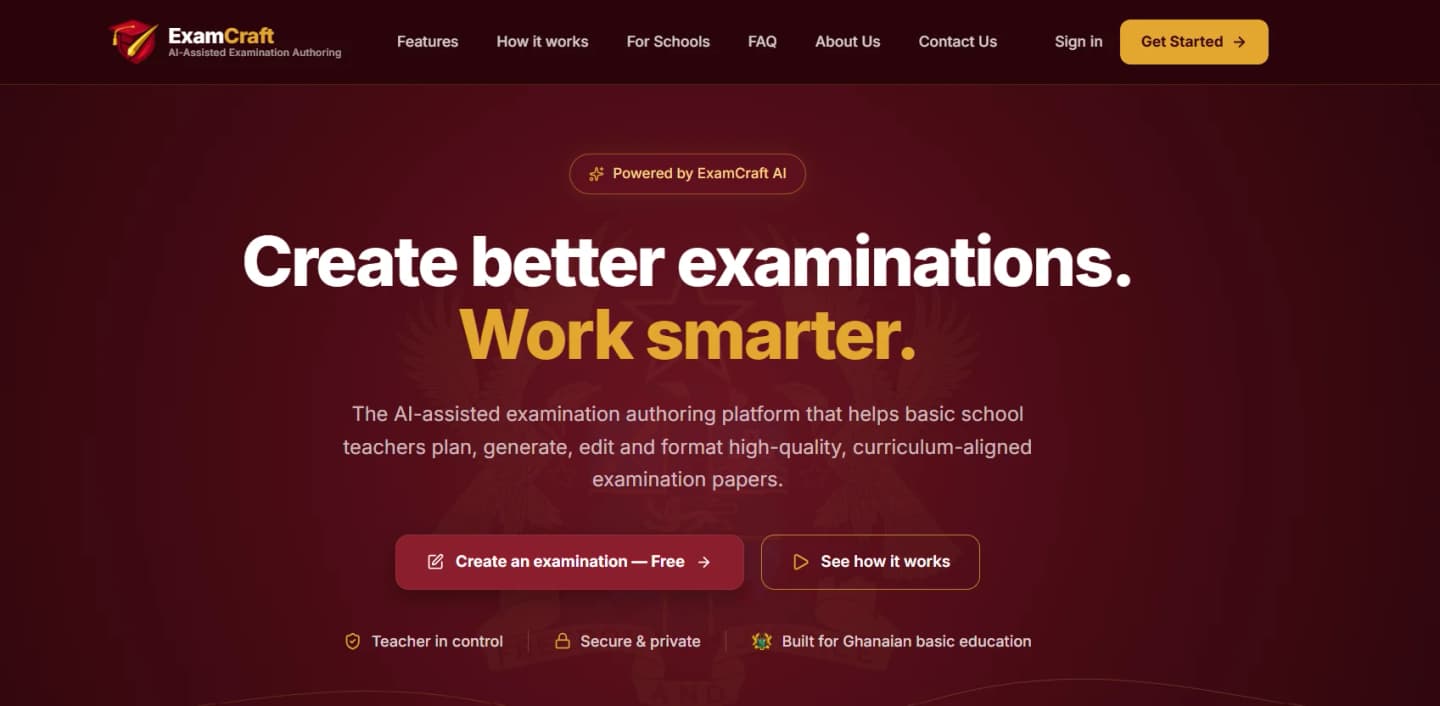
Every term, teachers in Ghana's basic schools set class tests, mid-term assessments and end-of-term examinations. Writing a good paper is skilled work. Each question should test something the learners were actually taught, at the right level of difficulty, with a correct answer key and a fair marking scheme. Then the paper has to be typed, laid out and printed. ExamCraft is an attempt to help with that work using artificial intelligence, without taking the work out of the teacher's hands. It began as the research project for my master's degree in Information Technology, which is still in progress, and it has grown into a working web application, available at examcraftgh.mosteksolutions.xyz. This article describes how it was designed, what proved difficult, and what still has to be shown.
The problem ExamCraft set out to address
More than writing questions
Producing an examination paper involves several distinct jobs:
choosing what to assess, from the curriculum and the scheme of learning;
writing questions at a suitable level of difficulty, in language the class can read;
for multiple-choice items, writing wrong options that are believable rather than obviously silly;
preparing an answer key and a marking scheme;
laying the paper out so that it prints cleanly and reads clearly.
Each of these takes time, and the quality of each affects how fairly the paper measures what learners know.
Why a general AI chatbot is not enough
General-purpose AI chat tools can produce questions on request, but they leave the hardest parts to the teacher. You have to know how to phrase the request. The tool has no idea which curriculum indicator a question is meant to assess unless you paste the indicator in yourself. Nothing checks that the answers, marks and sections add up. And the output still has to be copied, reformatted and laid out as a paper. (The wider question of AI in basic schools is discussed in a separate article.)
The question behind the project
The underlying question is simple to state and hard to answer: can AI help teachers produce examination papers that match Ghana's national curriculum, at a quality and cost that suit Ghanaian schools, while the teacher remains the author?
Design principles
The curriculum is the source of truth
ExamCraft's curriculum data was transcribed from the curriculum documents published by the National Council for Curriculum and Assessment (NaCCA), following their own structure: strand, sub-strand, content standard and indicator. Where a source document contains an error, such as a standard printed twice, it was kept exactly as printed rather than silently corrected.
Two smaller decisions follow from the same principle. Teachers choose topics, which map to NaCCA's sub-strands, because the curriculum itself defines sub-strands as "the topics within each strand under which the content is organised" (NaCCA, 2019). And ExamCraft does not assign topics to terms. The curriculum documents organise content by class, not by term, so a term schedule would have had to be invented.
The teacher never writes a prompt
Teachers describe the paper they want through a structured form, which I call a blueprint: class, subject, type of assessment, topics, sections and preferences. The system turns the blueprint into instructions for the AI. A teacher does not need to learn how to "talk to" an AI model to use it.
The teacher remains the author
Every generated question lands in an editor, where the teacher can rewrite it, regenerate just that one question, or delete it. Nothing reaches the printed page without the teacher's decision.
No learner data
ExamCraft works with papers, not pupils. It stores no information about learners.
How a teacher uses it
The workflow has six steps:
Set up the paper: class, subject and type of assessment: a class test, mid-term assessment, end-of-term examination or mock examination.
Choose what to assess: either browse the syllabus topics for that class and subject, or use the Smart Generator, which lets the teacher type what they taught in their own words and suggests the matching curriculum topics.
Shape the paper: sections, question types, numbers of questions and marks, starting from subject templates that follow the paper formats teachers already know.
Set preferences: such as the balance of easier and harder questions and whether to include an answer key.
Generate, then review: the questions appear in the editor for the teacher to check and change.
Print or export: as a printable paper or a Word document, with the school's own letterhead.
Inside the generation step
In plain terms, the blueprint and the relevant curriculum content are combined into a set of instructions. The AI model is asked to return structured data rather than free text: each question comes back with its wording, options, correct answer, marks and the indicator it targets.
The system then checks the result against the blueprint. Are there the right number of questions? Do the marks add up? Is every section present? If the check fails, it tries again, telling the model what was wrong, within a fixed limit. If it still fails, it reports the problem rather than producing a paper that is quietly incorrect.
ExamCraft is not tied to a single AI company. The generation step sits behind a common interface, so the underlying model can be changed without rebuilding the rest of the application.
Technical challenges
Turning curriculum documents into data
NaCCA's curriculum documents are PDFs designed to be read and printed, not processed by a computer. When their text is extracted, tables lose their shape, bullet symbols turn into stray characters, and different subjects follow slightly different conventions. The parser that turns them into structured data had to be tested and corrected against the real text many times, subject by subject, so that the indicators stored in ExamCraft read exactly as they do in the official documents.
Matching a teacher's words to the syllabus
Teachers rarely describe a lesson in the exact words of the curriculum. The Smart Generator has to connect "we did fractions and percentages" to the right sub-strands. It can fail in two ways, and they are not equally harmful.
A missed match is visible: the teacher sees that nothing was found and rephrases or browses the syllabus. A wrong match is invisible: a confidently selected topic that the class never studied can end up in the paper. So the design favours being right over being complete. Weak matches are offered as suggestions but never selected automatically, and every selected topic is shown so that the teacher can remove it.
Long papers and time limits
Web applications hosted on modern cloud platforms run each task under a time limit. A full examination booklet with several sections can take longer than that to generate in one piece. The solution was to generate a long paper one section at a time, saving each completed section, so a slow or failed step does not throw away the work already done.
A paper has to look like a paper
Teachers judge a tool partly by what comes out of the printer. A multiple-choice question should never be split across two pages. Answer space should reflect what a question is worth. Sections should be lettered consistently, and the Word version should match the printed one. Papers in Ghanaian languages also need letters such as ɛ, ɔ and ŋ, so the editor includes a special-characters palette for inserting them. None of this is glamorous, but it decides whether a teacher can use the result without retyping it.
Instructional challenges
Alignment is not the same as quality
A question can be tagged with exactly the right indicator and still be badly worded, too easy, or answerable by guessing. Linking each question to the curriculum is a starting point for quality, not a guarantee of it.
Different assessments do different jobs
A class test is not a shortened end-of-term examination, and a mid-term assessment should cover the work taught so far, not the whole year's syllabus. Encoding these differences into templates and instructions took several rounds of correction.
Judging difficulty
Labelling a question as easy or demanding, or as testing recall rather than reasoning, is a professional judgement. When an AI model applies those labels, they need the same scrutiny as the questions themselves.
Context and fairness
Names, places, prices and situations in questions should be familiar to Ghanaian learners, and no group of learners should be disadvantaged by unfamiliar references.
The risk of over-reliance
A busy teacher might accept generated questions without reading them closely. ExamCraft keeps the editor at the centre of the workflow, but software cannot guarantee careful review. The importance of that human check is the subject of a later article.
What has been shown, and what has not
Built and working: the workflow described above, from blueprint to printed paper or Word document. Curriculum data has been transcribed for a range of subjects and classes.
Tested by the developer: ExamCraft has automated tests that run whenever the code changes, including tests of the Smart Generator's topic matching against a set of sample teacher phrases. These tests are valuable for catching mistakes before they reach teachers. They also have an important limitation: the sample phrases were written by the developer, against the same curriculum data the matcher was built on. Passing them shows that the software still behaves as designed. It is not independent evidence that ExamCraft matches topics, or generates questions, accurately for the way real teachers describe their lessons.
Not yet shown: whether the questions are well aligned and of good quality in the judgement of experienced teachers, how much effort teachers save, and whether the cost is sustainable for schools. Those questions will be addressed through a formal evaluation as part of my MSc research, conducted under academic supervision and with the necessary ethical approval. Its findings will be reported when they are available.
Not endorsed: ExamCraft is not endorsed by, or affiliated with, the Ghana Education Service, NaCCA, the West African Examinations Council or any other government institution. "Curriculum-aligned" describes how the system is designed, with each question linked to an indicator from the published curriculum. It is not a certification. Mock examinations follow familiar formats but are not official papers.
Lessons for anyone building education software
Four lessons stand out. Start from the official source, and don't invent what it doesn't say: a missing term schedule is better than a made-up one. Design for the error the user cannot see, because wrong answers that look right do more harm than gaps that are obvious. Keep the professional as the author. And don't confuse a passing test with evidence: tests protect what you built, while evaluation tells you whether it works for the people you built it for.
Conclusion
ExamCraft started with a narrow question and has become a substantial piece of software, but the most important part of its journey is still ahead: finding out, with real teachers and independent reviewers, whether it does what it was designed to do. Until then, the honest description is that it is a working tool built on careful design decisions, not a proven one. You can try ExamCraft at examcraftgh.mosteksolutions.xyz, and see it alongside MosTek's other systems on the MosTek portfolio.
A check for any examination question, whoever or whatever wrote it: Which indicator does it assess? Is the answer key correct? Can the weakest reader in the class understand what is being asked? Would a learner who understood the topic get it right, and one who did not get it wrong? If you cannot answer all four, the question needs more work.
References
National Council for Curriculum and Assessment (2019). English Language Curriculum for Primary Schools (Basic 1–3), Organisation of the Curriculum. Ministry of Education, Ghana. PDF
National Council for Curriculum and Assessment. Curriculum documents for basic education. nacca.gov.gh
About the author
Moses Bentum
Moses Bentum is a Ghanaian educator, software developer, and founder of MosTek Solutions. With a background in Science Education and Information Technology, he develops innovative software solutions for schools and businesses. His interests include artificial intelligence, educational technology, data analytics, and digital transformation. Through MosTek Insights, he shares practical knowledge, research perspectives, and technology-driven solutions.
More from Moses Bentum